


Family Halictidae > Genus Agapostemon
Agapostemon
Metallic Green Sweat Bees
In Minnesota, there are six described species within the genus Agapostemon. Bees in this genus nest in the ground in either a solitary or communal nest. Agapostemon is one of four metallic green sweat bee genera that occur in Minnesota. The other three are Augochlora, Augochlorella, and Augochloropsis. In general, Agapostemon are larger than the other genera. Bees in this genus have a metallic green head and thorax, are medium-sized, and range in length from 7 to 18 mm (0.25 to 0.7 inches).
Agapostemon males have a black abdomen with yellow stripes, yellow legs, and a yellow labrum. Of the six species that occur in Minnesota, all females have a green abdomen except for Agapostemon virescens that has a black abdomen with white stripes. Females have a raised rim around the propodeum, and both males and females have gray-green compound eyes. Agapostemon are polylectic; that is, they do not specialize on particular plant pollens. However, they can be frequently observed visiting plants in the family Asteraceae, particularly from late spring until autumn.

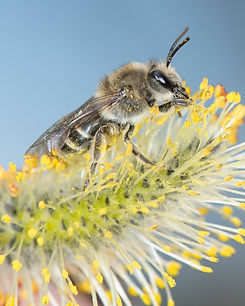
An Agapostemon virescens female visiting Rudbeckia hirta.

wing
position
on flowers

N0. species in MN
6
size range

Phenology


An Agapostemon virescens communal nest.
Genus Characteristics

Males and females with raised rim (carina) surrounding propodeum.

Females with metallic green head, thorax, and abdomen (except for A. virescens). Compound eyes gray-green and lacking significant indentations on inner margin.
Agapostemon sericeus

Agapostemon virescens
Females collect pollen on the hind leg femur and tibia.

Male with yellow-marked legs, green head and thorax, yellow-striped black abdomen, and yellow labrum.


Agapostemon Species in Minnesota
Scientific Name | Nest | Sociality |
|---|---|---|
Agapostemon angelicus | ground | solitary, communal |
Agapostemon sericeus | ground | solitary |
Agapostemon splendens | ground | solitary |
Agapostemon subtilior (majority formerly texanus) | ground | solitary |
Agapostemon texanus sensu stricto | ground | |
Agapostemon virescens | ground | communal |
Portman et al. (2024) reexamined the taxonomy of Agapostemon angelicus and Agapostemon texanus complex and discovered morphological differences between the females that historically could not be separated (males were the only ones that could be confidently separated). Their publication detailed identification characters for A. angelicus females and revealed that it has a broader range in Minnesota than previously thought. It also included taxonomic revisions resulting in the addition of one species to the 2023 state checklist, Agapostemon texanus. The authors reinstated the majority of the former Agapostemon texanus complex to Agapostemon subtilior and the remaining minority to Agapostemon texanus..
Source: Minnesota Department of Natural Resources, Minnesota Bee Species List (August 2023).
https://files.dnr.state.mn.us/eco/mcbs/mn-statewide-bee-list.pdf
Portman et al. (2024)
Distribution

Agapostemon angelicus

Agapostemon sericeus

Agapostemon splendens

Agapostemon subtilior
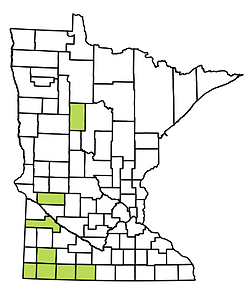
Agapostemon texanus

Agapostemon virescens

Agapostemon virescens female visiting Echinacea pallida

Explore More Halictidae Genera

Agapostemon

Augochlora

Augochlorella

Augochloropsis

Dieunomia

Dufourea

Halictus

Lasioglossum

Nomia

Sphecodes
Explore Bee Families


Apidae
15 genera, 133 species
Bumble bees Bombus
Longhorn bees
Epimelissodes, Eucera, Melissodes
Carpenter bees
Ceratina, Xylocopa
Honey bees Apis
Digger bees Anthophora
Cuckoo bees Brachymelecta, Epeolus, Holcopasites, Nomada, Neolarra, Triepeolus
Squash bees Xenoglossa
2 genera, 39 species

Halictidae
10 genera, 134 species
Metallic green sweat bees
Agapostemon, Augochlora, Augochlorella, Augochloropsis
Large sweat bees
Dieunomia, Nomia
Short-faced bees Dufourea
Sweat bees Halictus
Small sweat bees Lasioglossum
Cuckoo (blood) bees Sphecodes

Megachilidae
14 genera, 86 species
Resin and pebble bees Anthidiellum, Dianthidium, Heriades, Paranthidium
Carder bees Anthidium, Pseudoanthidium
Mock orange bees Chelostoma
Mason bees Osmia, Hoplitis
Leafcutter bees Megachile
Sharp-tailed cuckoo bees Coelioxys
Dark cuckoo bees Stelis

Citations and Further Reading
Droege, S., et al. (2024). The Very Handy Bee Manual: 2.0. How to Catch and Identify Bees and Manage a Collection.
Gibbs, J., Hanuschuk, E., Miller, R., Dubois, M., Martini, M., Robinson, S., ... & Onuferko, T. M. (2023). A checklist of the bees (Hymenoptera: Apoidea) of Manitoba, Canada. The Canadian Entomologist, 155, e3.
Mitchell, T. B. (1960). Bees of the eastern United States. Technical Bulletin No. 141. North Carolina Agricultural Experiment Station.
Portman, Z. M., Arduser, M., Powley, M. E., & Cariveau, D. P. (2024). Taxonomy of Agapostemon angelicus and the A. texanus species complex (Hymenoptera, Halictidae) in the United States. European journal of taxonomy, 958, 203-241.
Portman, Z. M., Arduser, M., Lane, I. G., & Cariveau, D. P. (2022). A review of the Augochloropsis (Hymenoptera, Halictidae) and keys to the shiny green Halictinae of the midwestern United States. ZooKeys, 1130, 103.
Portman, Z. M., Gardner, J., Lane, I. G., Gerjets, N., Petersen, J. D., Ascher, J. S., ... & Cariveau, D. P. (2023). A checklist of the bees (Hymenoptera: Apoidea) of Minnesota. Zootaxa, 5304(1), 1-95.
Wilson, J. S., & Messinger Carril, O. J. (2016). The bees in your backyard: a guide to North America's bees. Princeton University Press.