


Family Megachilidae > Genus Hoplitis
Hoplitis
Small Mason Bees
In Minnesota, there are five described species within the genus Hoplitis. All of these species are polylectic and have solitary nests aboveground in plant stems or cavities in wood. The nest brood cells are partitioned and lined with masticated leaves often combined with pith from the plant stem.
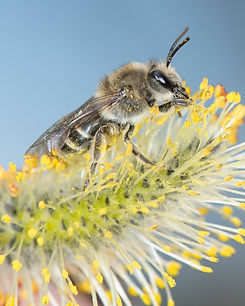
Hoplitis are small to medium black bees with light blue-green eyes, a moderately pitted thorax and abdomen, a rounded thorax, an arolium present (pad between tarsal claws), and white apical hair bands on the abdominal segments (tergites). These hair bands are interrupted on at least the first and second abdominal segments (T1 and T2). Hoplitis females collect pollen on hairs on the underside of their abdomen, and both males and females have a curling (concave) abdomen. Hoplitis males have unusual antennae that terminate in hooks or a sharp point, and some species have enlarged scapes. Some males also have a keel-like projection on their second sternite (underside of abdominal segment). Bees in this genus range in length from 6.5 to 13 mm (0.25 to 0.51 inches). The five species in Minnesota produce one generation per year (univoltine) and overwinter in a prepupal stage (in a spun silken cocoon). The following spring pupation occurs, then adults emerge in late spring.

A Hoplitis female visiting Penstemon hirsutus.

wing
position
on flowers

N0. species in MN
5
size range

Phenology

Genus Characteristics

Males with hooked antennae or antennae terminating in sharp point. Some species with enlarged scapes.
male

White hair bands on rims of tergites interrupted in the middle on at least the 1st and 2nd tergite (T1 and T2).
female

Black (not metallic) bees with white apical hair bands on the abdomen. Females collect pollen on hairs on the underside of the abdomen.
female

female
Light blue-green eyes, white hairs on thorax, moderately pitted integument.
Distribution

Hoplitis albifrons

Hoplitis pilosifrons

Hoplitis producta

Hoplitis spoliata

Hoplitis truncata
Hoplitis Species in Minnesota
Scientific Name | Nest Substrate | Nest Materials |
|---|---|---|
Hoplitis albifrons | wood, plant stems | masticated leaves mixed with pebbles |
Hoplitis pilosifrons | plant stems | masticated leaves mixed with stem pith |
Hoplitis producta | elderberry, sumac, rose stems | masticated leaves |
Hoplitis spoliata | dead sumac stems, + | masticated leaves |
Hoplitis truncata | plant stems |
Source: Minnesota Department of Natural Resources, Minnesota Bee Species List (August 2023).
https://files.dnr.state.mn.us/eco/mcbs/mn-statewide-bee-list.pdf
Explore More Megachilidae Genera
Note: Two genera/species on the state list are not included in this guide: Ashmeadiella bucconis (last seen in Minnesota in 1949) and Trachusa zebrata (last seen in Minnesota in 1939). If either of these species is rediscovered in the state, they will be added to the guide at that time.

Anthidiellum

Anthidium

Chelostoma

Coelioxys

Dianthidium

Heriades

Hoplitis

Megachile

Osmia

Paranthidium

Pseudoanthidium

Stelis
Explore Bee Families


Apidae
15 genera, 133 species
Bumble bees Bombus
Longhorn bees
Epimelissodes, Eucera, Melissodes
Carpenter bees
Ceratina, Xylocopa
Honey bees Apis
Digger bees Anthophora
Cuckoo bees Brachymelecta, Epeolus, Holcopasites, Nomada, Neolarra, Triepeolus
Squash bees Xenoglossa
2 genera, 39 species

Halictidae
10 genera, 134 species
Metallic green sweat bees
Agapostemon, Augochlora, Augochlorella, Augochloropsis
Large sweat bees
Dieunomia, Nomia
Short-faced bees Dufourea
Sweat bees Halictus
Small sweat bees Lasioglossum
Cuckoo (blood) bees Sphecodes

Megachilidae
14 genera, 86 species
Resin and pebble bees Anthidiellum, Dianthidium, Heriades, Paranthidium
Carder bees Anthidium, Pseudoanthidium
Mock orange bees Chelostoma
Mason bees Osmia, Hoplitis
Leafcutter bees Megachile
Sharp-tailed cuckoo bees Coelioxys
Dark cuckoo bees Stelis

Citations and Further Reading
Droege, S., et al. (2024). The Very Handy Bee Manual: 2.0. How to Catch and Identify Bees and Manage a Collection.
Gibbs, J., Hanuschuk, E., Miller, R., Dubois, M., Martini, M., Robinson, S., ... & Onuferko, T. M. (2023). A checklist of the bees (Hymenoptera: Apoidea) of Manitoba, Canada. The Canadian Entomologist, 155, e3.
Michener, C. D. (1947). A revision of the American species of Hoplitis (Hymenoptera, Megachilidae). Bulletin of the AMNH; v. 89, article 4.
Michener, C. D. (1955). Some biological observations on Hoplitis pilosifrons and Stelis lateralis (Hymenoptera, Megachilidae). Journal of the Kansas Entomological Society, 28(3), 81-87.
Mitchell, T. B. (1960). Bees of the eastern United States. Technical Bulletin No. 141. North Carolina Agricultural Experiment Station.
Portman, Z. M., Gardner, J., Lane, I. G., Gerjets, N., Petersen, J. D., Ascher, J. S., ... & Cariveau, D. P. (2023). A checklist of the bees (Hymenoptera: Apoidea) of Minnesota. Zootaxa, 5304(1), 1-95.
Rozen Jr, J. G., & Praz, C. J. (2016). Mature larvae and nesting biologies of bees currently assigned to the Osmiini (Apoidea: Megachilidae). American Museum Novitates, 2016(3864), 1-46.
Wilson, J. S., & Messinger Carril, O. J. (2016). The bees in your backyard: a guide to North America's bees. Princeton University Press.
Page Photography Credits
Heather Holm