


All About Bees > Bee Look-Alikes
Bee Look-Alikes
There are many regular flower-visiting insects—flies, wasps, beetles, moths, and more—with similar coloration, shape, and behaviors of bees. This mimicry provides these insects protection from potential predators such as birds or predatory insects since they resemble a stinging insect. It is easy to mistake a fly, wasp, moth, or other insect for a bee. See the traits and characteristics below to become versed in how to tell these insects apart:
TRAIT | BEE | WASP | FLY |
|---|---|---|---|
SHAPE | compact | elongate | compact |
WAIST | robust | narrow | none |
HAIRY | usually | rarely | sometimes |
WINGS | 4 wings, 2 pairs | 4 wings, 2 pairs | 2 wings |
ANTENNAE | long | long | short |
EYES | side of head | side of head | encompass whole head |
HIND LEG BASITARSUS | wide | narrow | variable |
POLLEN-COLLECTING STRUCTURES | most females | no | no |
LARVAL DIET | pollen, nectar | insects, spiders | many food sources |

FLY
compact shape
not hairy
short antennae
two wings
no defined waist
large eyes
no pollen-collecting structures

WASP
elongated shape
somewhat hairy
long antennae
four wings
defined waist
eyes on side of head
no pollen-collecting structures

WASP
elongate shape
not hairy
long antennae
four wings
defined waist
eyes on side of head
no pollen-collecting structures

BEE
compact shape
hairy
long antennae
four wings
defined waist
eyes on side of head
pollen-collecting structures (hind leg)
Insect Mimic Quiz
Ready to test your ID skills? Hover over each photo below for the correct answer.
1. Bumble Bee or Not?

Moth
Sphinx moth (Hemaris)

Flower Fly
Mallota bautias (Syrphidae)

Fly
Laphria thoracica (robber fly)
2. Green Insects

Wasp
Cuckoo wasp (Chrysididae)

Green Sweat Bee
Augochlora pura

Fly
Green bottle fly (Calliphoridae)
3. Insects With Red/Orange Abdomens

Bee
Sphecodes
(blood bee)

Flower Fly
Paragus (Syrphidae)

Wasp
Astata (Crabronidae)
4. Honey Bee-Like Insects

Drone Fly
Eristalis (Syrphidae)

Bee Fly
Poecilanthrax (Bombyliidae)

Bee
Apis mellifera (honey bee)
5. Black and Yellow Insects

Flower Fly
Somula (Syrphidae)

Resin Bee
Paranthidium (Megachilidae)

Flower Fly
Helophilus (Syrphidae)
All About Bees

What makes a bee, a bee? Are they just hairy wasps or are there more similarities than differences between bees and wasps? Learn about their evolution, some of the characteristics that make a bee, a bee, as well as their similarities and relationship to wasps.

There are many insects—flies, wasps, beetles, moths, and more—that resemble or mimic bees. Learn about some of these common mimics and develop skills to tell them apart from bees.

Cuckoo bees are cleptoparasitc and do not build their own nest. Instead, they either lay their eggs in a host bee nest where their larvae consume the pollen provisions provided by the host or, in the case of social parasites, take over the social nest of another bee.

About one-third of bees that occur in Minnesota specialize on collecting specific flower pollens. Learn about the flowering host plants that support specialists and the types of specialization.

Learn about the opportunities for identifying bees to species as well as the limitations. Approximately 20% of bees occurring in Minnesota could be identified to species using multiple clear photographs detailing specific identification characteristics.

Explore this photographic guide to bee anatomy and become familiar with the common body parts cited when identifying bees. Learn about specific things to look for when observing or photographing bees.

Bees nest in a variety of places either belowground or aboveground. Both ground-nesting and cavity-nesting bees line and waterproof their nests. Learn about which materials are used to ensure the larva has unspoiled food and a climate-controlled brood cell.

Each brood cell is stocked with pollen provisions, usually by a single female bee. Larvae consume these provisions as they develop. To sustain their activities, adult bees feed on pollen and nectar provided by flowers.

Most native bees have solitary nests and a minority land somewhere along a spectrum of sociality ranging from communal to social. Learn about these sociality categories and the life cycles of bees.

Do all bees live in hives and make honey? Do bees sting more than once or die after they sting? I saw a small bee, will it get larger once it consumes food? Myth-busting answers await!
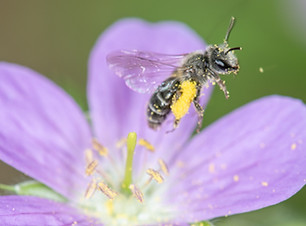
The intricate relationship between bees and flowers is often not mutualistic. Does a flower get pollinated each time a bee visits? What do flowers do to attract bees? What is pollination?

Observing bees is a really fun and enjoyable activity and bees occur in a variety of habitats including gardens, parks, field edges, and natural areas. Learn about some bee observation tips and where to look for bees.

Where do bees spend the night? How do they find a mate? How do females collect pollen? How do they find their nests? What is buzz pollination?

Bees have a number of natural enemies that prey on them, parasitize adults or larvae, consume the larval provisions, or threaten their health or survival.
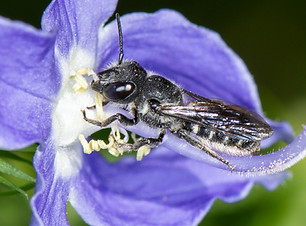
A number of factors, often a combination of many interacting simultaneously, can threaten native bees. These may include habitat loss and fragmentation, exposure to pesticides, and pathogen spillover.
Explore Bee Families


Apidae
15 genera, 133 species
Bumble bees Bombus
Longhorn bees
Epimelissodes, Eucera, Melissodes
Carpenter bees
Ceratina, Xylocopa
Honey bees Apis
Digger bees Anthophora
Cuckoo bees Brachymelecta, Epeolus, Holcopasites, Nomada, Neolarra, Triepeolus
Squash bees Xenoglossa
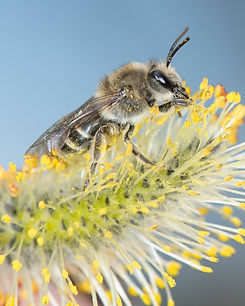
2 genera, 39 species

Halictidae
10 genera, 134 species
Metallic green sweat bees
Agapostemon, Augochlora, Augochlorella, Augochloropsis
Large sweat bees
Dieunomia, Nomia
Short-faced bees Dufourea
Sweat bees Halictus
Small sweat bees Lasioglossum
Cuckoo (blood) bees Sphecodes

Megachilidae
14 genera, 86 species
Resin and pebble bees Anthidiellum, Dianthidium, Heriades, Paranthidium
Carder bees Anthidium, Pseudoanthidium
Mock orange bees Chelostoma
Mason bees Osmia, Hoplitis
Leafcutter bees Megachile
Sharp-tailed cuckoo bees Coelioxys
Dark cuckoo bees Stelis

Page Photography Credits
Heather Holm