


Family Apidae > Genus Epimelissodes
Epimelissodes
Longhorn Bees
In Minnesota, there are two described species within the genus Epimelissodes (formerly Svastra). Both species are uncommon to rare. Bees in this genus resemble Melissodes but are generally larger in size. Epimelissodes nest in the ground and have solitary nests. One of the two species in Minnesota, Epimelissodes obliqua, is a pollen specialist of late summer-blooming plants in the family Asteraceae. Epimelissodes females collect pollen on long hairs on their hind leg tibiae.
Epimelissodes males have a brightly colored (white or light yellow) clypeus and long antennae. Both males and females have oval tegulae, a long glossa (tongue), a head that is as wide as the thorax, and a tuft of hairs on the metanotum (rear section of the thorax). Males have blue-green eyes and light-colored mandibles. Note: It is very difficult to tell Epimelissodes apart from Melissodes from an observation or photograph. Melissodes are much more common however, and both genera are active at the same time. Epimelissodes range in length from 10 to 21 mm (0.39 to 0.83 inches).

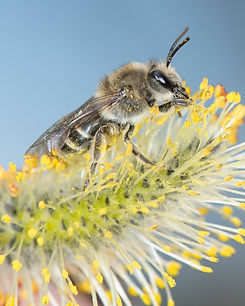
Epimelissodes atripes atripes female visiting Monarda punctata.


Wing
position
on flowers
2
no. species
in MN
size range

Phenology

Genus Characteristics
Males with long antennae, white or light yellow clypeus, light mandibles, and blue-green eyes.
Males and females with oval tegula, a head as wide as the thorax, and robust shape.

Females with long pollen-collecting hairs on the hind leg tibia and basitarsus.
female


Epimelissodes Species in Minnesota
Scientific Name | Likely Lecty | Host |
|---|---|---|
Epimelissodes atripes | polylectic | |
Epimelissodes obliqua | oligolectic | Helianthus (Arduser) |
Source: Minnesota Department of Natural Resources, Minnesota Bee Species List (August 2023).
https://files.dnr.state.mn.us/eco/mcbs/mn-statewide-bee-list.pdf
Explore More Apidae Genera

Anthophora

Apis

Bombus

Brachymelecta

Ceratina

Epeolus

Epimelissodes

Eucera

Holcopasites

Melissodes

Neolarra

Nomada

Triepeolus

Xenoglossa

Xylocopa
Explore Bee Families


Apidae
15 genera, 133 species
Bumble bees Bombus
Longhorn bees
Epimelissodes, Eucera, Melissodes
Carpenter bees
Ceratina, Xylocopa
Honey bees Apis
Digger bees Anthophora
Cuckoo bees Brachymelecta, Epeolus, Holcopasites, Nomada, Neolarra, Triepeolus
Squash bees Xenoglossa
2 genera, 39 species

Halictidae
10 genera, 134 species
Metallic green sweat bees
Agapostemon, Augochlora, Augochlorella, Augochloropsis
Large sweat bees
Dieunomia, Nomia
Short-faced bees Dufourea
Sweat bees Halictus
Small sweat bees Lasioglossum
Cuckoo (blood) bees Sphecodes

Megachilidae
14 genera, 86 species
Resin and pebble bees Anthidiellum, Dianthidium, Heriades, Paranthidium
Carder bees Anthidium, Pseudoanthidium
Mock orange bees Chelostoma
Mason bees Osmia, Hoplitis
Leafcutter bees Megachile
Sharp-tailed cuckoo bees Coelioxys
Dark cuckoo bees Stelis

Citations and Further Reading
Droege, S., Shumar, S., & Maffei, C. (2024). The Very Handy Bee Manual (2.0). Zenodo. https://doi.org/10.5281/zenodo.12812755
Mitchell, T. B. (1960). Bees of the eastern United States. Technical Bulletin No. 141. North Carolina Agricultural Experiment Station.
Portman, Z. M., Gardner, J., Lane, I. G., Gerjets, N., Petersen, J. D., Ascher, J. S., ... & Cariveau, D. P. (2023). A checklist of the bees (Hymenoptera: Apoidea) of Minnesota. Zootaxa, 5304(1), 1-95.
Wilson, J. S., & Messinger Carril, O. J. (2016). The bees in your backyard: a guide to North America's bees. Princeton University Press.
Page Photography Credits
Heather Holm
Steve Mlodinow CC BY-NC 4.0 (Brachymelecta)
Michelle Orcutt CC-BY-NC 4.0 (Epimelissodes female)