


Family Colletidae > Genus Colletes
Colletes
Cellophane (Plasterer) Bees
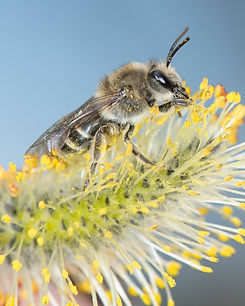
In Minnesota, there are twenty-five described species within the genus Colletes. Bees in this genus nest in the ground and have solitary nests. It is not uncommon for some species to nest in aggregations in well-drained soil such as sand. Colletes have large round abdomens often with continuous white hair bands, converging eyes resulting in a tapered (heart-shaped) face, a short bilobed or forked glossa (tongue), three forewing submarginal cells, and an S-shaped second recurrent vein (forewing). Females have pollen-collecting hairs on their hind leg femora and tibiae. They also have broad rounded abdomen that houses an enlarged Dufour's gland. Secretions from this gland, combined with saliva, form the waterproof cellophane-like lining in nest brood cells. Bees in this genus are small-medium to medium-sized and range in length from 6 to 15 mm (0.24 to 0.6 inches).
Twenty-two or the majority of Colletes species that occur in Minnesota are pollen-collecting specialists (oligoleges). Many of the host plants bloom in summer or early fall. For example, in Minnesota, host plants in the plant genera Dalea, Amorpha, Solidago, Symphyotrichum, and Physalis support two or more Colletes specialists.

Colletes simulans armatus is a specialist of Solidago and Symphyotrichum.

wing
position
on flowers

N0. species in MN
25
size range

Phenology

Genus Characteristics

Face tapered (heart-shaped).

Ground-nesting

1
2
S
3
Forewing with three submarginal cells and an S-shaped 2nd recurrent vein. 2nd and 3rd submarginal cells similar width and smaller than 1st cell.

Pygidial plate absent.

Males and females with dense hair on face and thorax. Often with pale apical hair bands on abdomen.

Females with pollen-collecting hairs on the hind leg tibiae, femora, and on the side of the thorax.


Colletes Species in Minnesota
Scientific Name | Likely Lecty | Host |
|---|---|---|
Colletes aberrans | narrow oligolectic | Dalea (Arduser); Amorpha canescens (Wilhelm and Rericha, 2017); July - August |
Colletes albescens | monolectic | Amorpha canescens (Arduser) |
Colletes americanus | oligolectic | Asteraceae (Gibbs 2023), Symphyotrichum, Solidago (Arduser); July - September |
Colletes andrewsi | monolectic | Heuchera richardsonii (Gibbs 2023 & Arduser); May - July |
Colletes brevicornis | narrow oligolectic | Campanula (Gibbs 2023 & Arduser); Triodanis perfoliata (Wilhelm and Rericha, 2017); May - June |
Colletes ciliatus | narrow oligolectic | Cuscuta; August - September |
Colletes compactus | oligolectic | Symphyotrichum, Solidago (Arduser); August - October |
Colletes consors | narrow oligolectic | Phacelia (Gibbs 2023) |
Colletes hyalinus hyalinus | polylectic | |
Colletes impunctatus | narrow oligolectic | Gayussacia (Gibbs 2023); July |
Colletes inaequalis | polylectic | Salix, Acer rubrum, ++; Late March - early May |
Colletes kincaidii | oligolectic? | likely Fabaceae specialist (Portman); June - August |
Colletes latitarsis | narrow oligolectic | Physalis (Arduser); June - August |
Colletes mandibularis | eclectic oligolectic | Amorpha, Dalea early summer; Heterotheca, Solidago, Chrysopsis late summer (Arduser) |
Colletes nudus | narrow oligolectic | Rhus (Arduser); June - August |
Colletes phaceliae | oligolectic | |
Colletes robertsonii | oligolectic | Fabaceae (Gibbs 2023), Dalea, Amorpha canescens (Arduser) |
Colletes rufocinctus | oligolectic | Asteraceae (Gibbs 2023), late summer Asteraceae genera (Arduser) |
Colletes simulans | oligolectic | Solidago, Symphyotrichum (Gibbs 2023 & Arduser) |
Colletes solidaginis | oligolectic | Solidago (Arduser); July - August |
Colletes speculiferus | oligolectic | Solidago and other late-blooming Asteraceae (Arduser); September - October |
Colletes susannae | narrow oligolectic | Dalea (Gibbs 2023 & Arduser); July - August |
Colletes validus | oligolectic | Eriaceae (Gibbs 2023), Vaccinium (Arduser); April - June |
Colletes willistoni | narrow oligolectic | Physalis (Gibbs 2023 & Arduser); July |
Colletes wilmattae | narrow oligolectic | Dalea (Arduser); July - August |
Source: Minnesota Department of Natural Resources, Minnesota Bee Species List (August 2023).
https://files.dnr.state.mn.us/eco/mcbs/mn-statewide-bee-list.pdf
Distribution


Colletes compactus

Colletes consors

Colletes hyalinus hyalinus

Colletes impunctatus

Colletes inaequalis

Colletes kincaidii

Colletes latitarsis

Colletes mandibularis

Colletes nudus

Colletes phaceliae

Colletes robertsonii

Colletes rufocinctus

Colletes simulans

Colletes solidaginis

Colletes speculiferus

Colletes susannae

Colletes validus

Colletes willistoni

Colletes wilmattae
Portman et al (2023)
Additional Record
Explore More Colletidae Genera

Colletes

Hylaeus
Explore Bee Families


Apidae
15 genera, 133 species
Bumble bees Bombus
Longhorn bees
Epimelissodes, Eucera, Melissodes
Carpenter bees
Ceratina, Xylocopa
Honey bees Apis
Digger bees Anthophora
Cuckoo bees Brachymelecta, Epeolus, Holcopasites, Nomada, Neolarra, Triepeolus
Squash bees Xenoglossa
2 genera, 39 species

Halictidae
10 genera, 134 species
Metallic green sweat bees
Agapostemon, Augochlora, Augochlorella, Augochloropsis
Large sweat bees
Dieunomia, Nomia
Short-faced bees Dufourea
Sweat bees Halictus
Small sweat bees Lasioglossum
Cuckoo (blood) bees Sphecodes

Megachilidae
14 genera, 86 species
Resin and pebble bees Anthidiellum, Dianthidium, Heriades, Paranthidium
Carder bees Anthidium, Pseudoanthidium
Mock orange bees Chelostoma
Mason bees Osmia, Hoplitis
Leafcutter bees Megachile
Sharp-tailed cuckoo bees Coelioxys
Dark cuckoo bees Stelis

Citations and Further Reading
Droege, S., et al. (2024). The Very Handy Bee Manual: 2.0. How to Catch and Identify Bees and Manage a Collection.
Gibbs, J., Hanuschuk, E., Miller, R., Dubois, M., Martini, M., Robinson, S., ... & Onuferko, T. M. (2023). A checklist of the bees (Hymenoptera: Apoidea) of Manitoba, Canada. The Canadian Entomologist, 155, e3.
Mitchell, T. B. (1960). Bees of the eastern United States. Technical Bulletin No. 141. North Carolina Agricultural Experiment Station.
Portman, Z. M., Gardner, J., Lane, I. G., Gerjets, N., Petersen, J. D., Ascher, J. S., ... & Cariveau, D. P. (2023). A checklist of the bees (Hymenoptera: Apoidea) of Minnesota. Zootaxa, 5304(1), 1-95.
Wilson, J. S., & Messinger Carril, O. J. (2016). The bees in your backyard: a guide to North America's bees. Princeton University Press.
Page Photography Credits
Heather Holm