


Family Andrenidae > Genus Perdita
Perdita
Fairy Bees
In Minnesota, there are twelve described species within the genus Perdita. The majority of these species are active in July and August when their pollen host plants are flowering. In fact, all twelve species in Minnesota are pollen specialists (oligoleges). Some species specialize on a single plant genus and others on a few plant genera within the same plant family.
Perdita (fairy bees) are extremely tiny, sparsely-haired, and range in length from 2 to 10 mm (0.1 to 0.4"). All species in this genus nest in the ground and have solitary nests. Perdita habitat includes sandy sites that supply an abundance of pollen host plants such as Dalea (prairie clover), Helianthus (sunflower), Solidago (goldenrod), and Physalis (ground cherry).

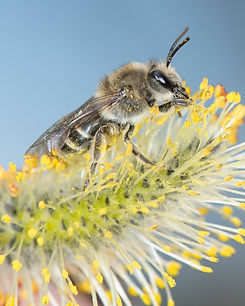
Perdita swenki visiting Heterotheca villosa


Wing
position
on flowers
12
no. species
in MN
size range

Phenology

Genus Characteristics
Extremely tiny
Abdomen appears flattened
Pollen-collecting hairs on hind leg tibia and basitarsus
Pollen loads can be dry or moistened masses
Short forewing marginal cell

Face wider than tall. Facial foveae narrow. Two subantennal sutures.

Pollen-collecting hairs (scopae) on hind tibiae and basitarsi.

1
Marginal
Cell
Stigma
2
Marginal cell short and squared off, as long or slightly longer than stigma. Second submarginal cell shorter than first.

Abdomen flattened and usually with white or yellow markings; tergites 1-4 relatively hairless.

Many species with hyaline (translucent or light-colored) wings.


Distribution

Perdita albipennis

Perdita bruneri

Perdita halictoides

Perdita ignota

Perdita perpallida

Perdita swenki

Perdita dolichocephala

Perdita fallax

Perdita gerhardi

Perdita maculigera

Perdita octomaculata

Perdita pallidipennis
Portman et al (2023)
Additional Record
Perdita Species in Minnesota
Scientific Name | Likely Lecty | Host Plant(s) |
|---|---|---|
Perdita albipennis | narrow oligolectic | Helianthus (Gibbs 2023 and Arduser) |
Perdita bruneri | oligolectic | Asteraceae (Gibbs 2023), Solidago, Grindelia (Arduser) |
Perdita dolichocephala | narrow oligolectic | Helianthus (Arduser) |
Perdita fallax | narraow oligolectic | Helianthus (Gibbs 2023) |
Perdita gerhardi | monolectic | Monarda punctata (Arduser) |
Perdita halictoides | narrow oligolectic | Physalis (Gibbs 2023 and Arduser) |
Perdita ignota | oligolectic | Grindelia, Heterotheca, Chrysopsis (Arduser) |
Perdita maculigera | narrow oligolectic | Salix (Gibbs 2023 and Arduser) |
Perdita octomaculata | narrow oligolectic | Solidago (Gibbs 2023 and Arduser); Doellingeria umbellata, Solidago altissima, Solidago gigantea (Wilhelm and Rericha, 2017) |
Perdita pallidipennis | oligolectic | Asteraceae (Rochet al. 2021) |
Perdita perpallida | narrow oligolectic | Dalea (Gibbs 2023 and Arduser) |
Perdita swenki | oligolectic | Solidago (Arduser), Grindelia, Heterotheca, Helianthus, Solidago (Fowler) |
Lecty/Host Plant Information: Minnesota Department of Natural Resources, Minnesota Bee Species List (August 2023).
https://files.dnr.state.mn.us/eco/mcbs/mn-statewide-bee-list.pdf

Perdita perpallida females collect the bright orange pollen from their host plant, Dalea purpurea (purple prairie clover). Where this bee species occurs, it's quite common to find mating pairs on flowers.
Explore More Andrenidae Genera

Andrena

Calliopsis

Perdita

Protandrena
Explore Bee Families


Apidae
15 genera, 133 species
Bumble bees Bombus
Longhorn bees
Epimelissodes, Eucera, Melissodes
Carpenter bees
Ceratina, Xylocopa
Honey bees Apis
Digger bees Anthophora
Cuckoo bees Brachymelecta, Epeolus, Holcopasites, Nomada, Neolarra, Triepeolus
Squash bees Xenoglossa
2 genera, 39 species

Halictidae
10 genera, 134 species
Metallic green sweat bees
Agapostemon, Augochlora, Augochlorella, Augochloropsis
Large sweat bees
Dieunomia, Nomia
Short-faced bees Dufourea
Sweat bees Halictus
Small sweat bees Lasioglossum
Cuckoo (blood) bees Sphecodes

Megachilidae
14 genera, 86 species
Resin and pebble bees Anthidiellum, Dianthidium, Heriades, Paranthidium
Carder bees Anthidium, Pseudoanthidium
Mock orange bees Chelostoma
Mason bees Osmia, Hoplitis
Leafcutter bees Megachile
Sharp-tailed cuckoo bees Coelioxys
Dark cuckoo bees Stelis

Citations and Further Reading
Droege, S., Shumar, S., & Maffei, C. (2024). The Very Handy Bee Manual (2.0). Zenodo. https://doi.org/10.5281/zenodo.12812755
Fowler, J. (2020) Pollen Specialist Bees of the Central United States. https://jarrodfowler.com/bees_pollen.html
Gibbs, J., Hanuschuk, E., Miller, R., Dubois, M., Martini, M., Robinson, S., ... & Onuferko, T. M. (2023). A checklist of the bees (Hymenoptera: Apoidea) of Manitoba, Canada. The Canadian Entomologist, 155, e3.
Mitchell, T. B. (1960). Bees of the eastern United States. Technical Bulletin No. 141. North Carolina Agricultural Experiment Station.
Portman, Z. M., Gardner, J., Lane, I. G., Gerjets, N., Petersen, J. D., Ascher, J. S., ... & Cariveau, D. P. (2023). A checklist of the bees (Hymenoptera: Apoidea) of Minnesota. Zootaxa, 5304(1), 1-95.
Wilson, J. S., & Messinger Carril, O. J. (2016). The bees in your backyard: a guide to North America's bees. Princeton University Press.
Page Photography Credits
Heather Holm