


Bombus terricola
Yellow-banded Bumble Bee
Bombus terricola occurs in northeastern Minnesota, north of the Twin Cities, but is absent in the south and southwest. Rare in Minnesota and across its North American range, the conservation status of this species is S2 (imperiled) because the population has significantly declined. Climate change and pathogens are two primary factors likely leading to its decline. New queens (gynes) begin emerging from hibernation in May then establish a nest belowground in or near woodlands. Workers begin emerging in early June, males in early July, and gynes in mid-August.
This is a short-tongued bumble bee with a robust or rotund form. Females have short even hair and males have long hair. Bombus terricola resembles Bombus auricomus and Bombus pensylvanicus. One difference is B. terricola females have a fringe of light hairs on the fifth tergite (T5) and males on T5 and T6, a trait absent for B. auricomus and B. pensylvanicus. Bombus terricola has black hairs on T1, yellow hairs on T2 and T3, and black hairs on T4-T6 (females) and T4-T7 (males), in addition to the fringe of light hairs mentioned above. Both males and females have extensive areas of black hair on the thorax, between the wing bases and extending to the rear of the thorax. Some color variations include light hairs mixed with the black hairs on the rear of the thorax. The head is broader than long and females have dark hairs on the vertex (back of the head or neck) and face, occasionally with a mixture of light hairs; males have light and dark hairs on the vertex and face.

male

NatureServe State Conservation Status
size range

QUEEN
size range

WORKER
size range

MALE
Wing position on flowers


range
Species Characteristics

female
Black hair on side of thorax and abdomen
Mix of black and
light hairs on vertex
Corbicula
present
Yellow hair on front of thorax
Yellow hair on
T2 and T3
Black hair between wing bases
Wings dark brown
Yellow fringe on T5
Dark hairs on face

female

Corbicula
absent
Yellow hair
on T5-T6
male
Light hair mixed with
black on vertex
Black hairs on thorax between wing bases
extending to rear of thorax
Wings medium brown
Yellow hairs on T2 and T3
Light hair mixed with
black on face

male
Similar-Looking Species

Bombus auricomus

Bombus pensylvanicus

Bombus fervidus

Bombus borealis
Plant
Associations
Bombus terricola is a short-tongued bumble bee species that often nectar robs from flowers with long corollas such as Monarda and Dicentra. Flowering plants in the family Asteraceae offering shallow nectaries are frequently visited by this bumble bee species.

Thalictrum dasycarpum
(tall meadowrue)

Asclepias syriaca
(common milkweed)

Veronicastrum virginicum
(Culver's root)

Verbena hastata
(blue vervain)

Eutrochium purpureum
(sweet Joe Pye weed)

Eupatorium perfoliatum
(common boneset)

Agastache foeniculum
(anise hyssop)

Helianthus
(sunflowers)

Monarda fistulosa
(wild bergamot)

Chamaenerion angustifolium
(fireweed)
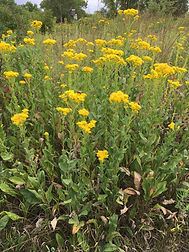
Solidago, Euthamia
(goldenrods)

Spiraea alba
(white meadowsweet)

Asclepias incarnata
(swamp milkweed)

Heliopsis helianthoides
(smooth oxeye)

Dicentra cucullaria
(Dutchman's breeches)

Rosa blanda
(smooth wild rose)

Acer rubrum
(red maple)

Salix
(willows)

Cirsium discolor
(pasture thistle)

Symphyotrichum, Eurybia
(asters)

Pycnanthemum virginianum
(Virginia mountain mint)

Apocynum androsaemifolium
(spreading dogbane)

Asclepias tuberosa
(butterfly milkweed)


Bombus Species in Minnesota
Scientific Name | Host | Sociality | Nest |
|---|---|---|---|
Bombus affinis | eusocial | below- and on the ground | |
Bombus ashtoni (B. bohemicus) | Bombus affinis and B. terricola. SH rank: possibly extirpated from state | parasitic | |
Bombus auricomus | eusocial | below- and aboveground | |
Bombus bimaculatus | eusocial | below- and on the ground | |
Bombus borealis | eusocial | on the ground | |
Bombus citrinus | Bombus bimaculatus, B. impatiens, B. vagans (Gibbs 2023) | parasitic | |
Bombus fervidus | eusocial | below- and on the ground | |
Bombus flavidus (B. fernalde) | Bombus | parasitic | |
Bombus fraternus | eusocial | belowground | |
Bombus frigidus | eusocial | ||
Bombus griseocollis | eusocial | below- and aboveground | |
Bombus huntii | eusocial | ||
Bombus impatiens | eusocial | belowground | |
Bombus insularis | Bombus ternarius (Williams et al. 2014) B. terricola (Hobbs 1968) | parasitic | |
Bombus melanopygus | eusocial | ||
Bombus nevadensis | eusocial | below- and aboveground | |
Bombus pensylvanicus | eusocial | belowground, on the ground in grasslands, in wood cavities aboveground | |
Bombus perplexus | eusocial | on the ground next to or under objects | |
Bombus rufocinctus | eusocial | on the ground under objects | |
Bombus sandersoni | eusocial | ||
Bombus suckleyi | Bombus - SX rank: presumed extirpated from state | parasitic | |
Bombus ternarius | eusocial | belowground in or next to treed habitat | |
Bombus terricola | eusocial | below- and on the ground | |
Bombus vagans | eusocial | on the ground under debris or object | |
Bombus variabilis | B. pensylvanicus. - SX rank: presumed extirpated from state | parasitic |
Source: Minnesota Department of Natural Resources, Minnesota Bee Species List (August 2023).
https://files.dnr.state.mn.us/eco/mcbs/mn-statewide-bee-list.pdf


_Page_1.jpg)
_Page_2.jpg)
Distribution

Bombus affinis

Bombus ashtoni (bohemicus)

Bombus auricomus


Bombus bimaculatus


Bombus Annual Nest Cycle

Gynes emerge from hibernation.
Workers emerge from nest and collect pollen and nectar.
Gynes establish nest and collect pollen and nectar from flowers.
Gynes search for a nest site.
Males begin emerging.
Some males
establish
territories.
New gynes emerge from nest and visit flowers to sequester fat.
New gynes mate
with a male.
New gynes excavate a
shallow hibernation burrow.
NEST ESTABLISHED
NEST ENDS
Males, workers, and queen perish.
Participatory Science Opportunities



Explore More Apidae Genera

Anthophora

Apis

Bombus

Brachymelecta

Ceratina

Epeolus

Epimelissodes

Eucera

Holcopasites

Melissodes

Neolarra

Nomada

Triepeolus

Xenoglossa

Xylocopa
Explore Bee Families


Apidae
15 genera, 133 species
Bumble bees Bombus
Longhorn bees
Epimelissodes, Eucera, Melissodes
Carpenter bees
Ceratina, Xylocopa
Honey bees Apis
Digger bees Anthophora
Cuckoo bees Brachymelecta, Epeolus, Holcopasites, Nomada, Neolarra, Triepeolus
Squash bees Xenoglossa
2 genera, 39 species

Halictidae
10 genera, 134 species
Metallic green sweat bees
Agapostemon, Augochlora, Augochlorella, Augochloropsis
Large sweat bees
Dieunomia, Nomia
Short-faced bees Dufourea
Sweat bees Halictus
Small sweat bees Lasioglossum
Cuckoo (blood) bees Sphecodes

Megachilidae
14 genera, 86 species
Resin and pebble bees Anthidiellum, Dianthidium, Heriades, Paranthidium
Carder bees Anthidium, Pseudoanthidium
Mock orange bees Chelostoma
Mason bees Osmia, Hoplitis
Leafcutter bees Megachile
Sharp-tailed cuckoo bees Coelioxys
Dark cuckoo bees Stelis

Citations and Further Reading
Droege, S., Shumar, S., & Maffei, C. (2024). The Very Handy Bee Manual (2.0). Zenodo. https://doi.org/10.5281/zenodo.12812755
Gibbs, J., Hanuschuk, E., Miller, R., Dubois, M., Martini, M., Robinson, S., ... & Onuferko, T. M. (2023). A checklist of the bees (Hymenoptera: Apoidea) of Manitoba, Canada. The Canadian Entomologist, 155, e3.
Mitchell, T. B. (1960). Bees of the eastern United States. Technical Bulletin No. 141. North Carolina Agricultural Experiment Station.
Portman, Z. M., Gardner, J., Lane, I. G., Gerjets, N., Petersen, J. D., Ascher, J. S., ... & Cariveau, D. P. (2023). A checklist of the bees (Hymenoptera: Apoidea) of Minnesota. Zootaxa, 5304(1), 1-95.
Williams, P. H., Thorp, R. W., Richardson, L. L., & Colla, S. R. (2014). Bumble bees of North America: an identification guide. Princeton University Press
Wilson, J. S., & Messinger Carril, O. J. (2016). The bees in your backyard: a guide to North America's bees. Princeton University Press.
Page Photography Credits
Heather Holm
Kent P. McFarland Public Domain (Bombus pensylvanicus male)
Steve Mlodinow CC BY-NC 4.0 (Brachymelecta)
Michelle Orcutt CC-BY-NC 4.0 (Epimelissodes female)
Page Illustration Credits
Elaine Evans, Xerces Society - bumble bee illustrations