


Bombus affinis
Rusty patched Bumble Bee
In 2019, the rusty patched bumble bee became Minnesota's state bee. Once common throughout the eastern United States and Midwest, its historic range has substantially contracted and this species now occurs in a small fraction of its former range. After The Xerces Society petitioned the U.S. Fish and Wildlife Service to list the species for protection under the Endangered Species Act, the Service formally listed the bee as federally endangered in January, 2017. To date, scattered rusty patched bumble bee populations still persist in Minnesota.
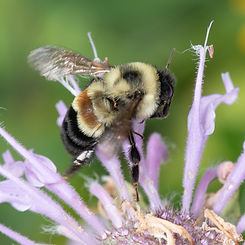
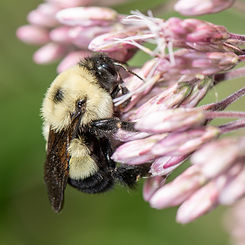
Queens have a different coloration pattern than workers and males: Queens lack bright orange hairs on the base of the second tergite (T2) and have a distinct black dot on the top of the thorax. Workers have an upside-down T-shaped black marking on the thorax; males a broad black band between the wing bases. Queens, workers and males have yellow hairs on the first and second tergites (T1 and T2) and the remaining tergites have black hairs. Males have scattered yellow hairs on the vertex (back of the head or "neck") and dark hairs on the face; queens and workers have dark hairs on the vertex and face. All castes have dark brown wings.

male

NatureServe State Conservation Status
size range

QUEEN
size range

WORKER
size range

MALE
Wing position on flowers


range
Species Characteristics

queen
Black dot on top of thorax
Black hair on face
Yellow hairs on T1-T2
Black hair on T3-T6
Corbicula
present
Wings
dark
brown
Black hair on edge of abdomen

queen

Black hair
on face
Corbicula
present
Orange hair on base of T2 edged with yellow hair
Yellow hair on T1-T2
worker
Black hair
on vertex
Black "T" on thorax
Black hair on T3-T6

worker

Black hair
on face
Corbicula
absent
Orange hair on base on T2 edged with yellow hair
Yellow hair on T1
male
Yellow hair
on vertex
Black band
between wing bases
Black hair on T3-T7

male

male

male

queen
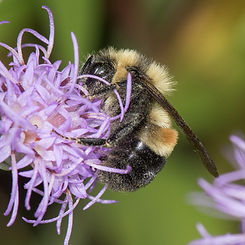
male

male
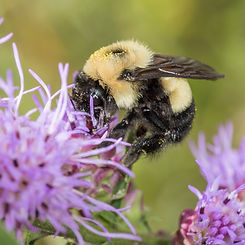
gyne

worker
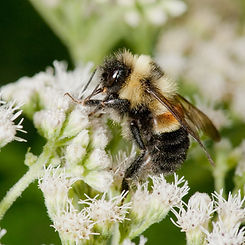
male
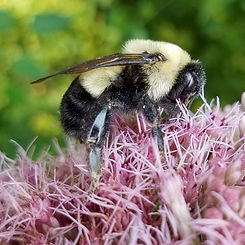
gyne
worker

gyne

queen

worker
gyne

worker

male
Bombus affinis Life Cycle in Minnesota

Similar-Looking Species

Bombus rufocinctus

Bombus griseocollis

Bombus vagans

Bombus huntii
Plant
Associations
Bombus affinis is a short-tongued bumble bee species. Males and workers rob nectar by chewing a hole, providing an entry point for their tongue, at the base of a long flower corolla. Monarda fistulosa is a plant frequented by males and workers and one that this bumble bee robs nectar from.

Monarda fistulosa
(wild bergamot)

Veronicastrum virginicum
(Culver's root)

Eutrochium purpureum
(sweet Joe Pye weed)

Hydrophyllum virginianum
(Virginia waterleaf)

Asclepias incarnata
(swamp milkweed)

Vaccinium
(blueberry)
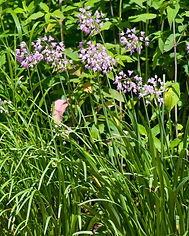
Allium cernuum
(nodding onion)

Asclepias tuberosa
(butterfly milkweed)

Campanulastrum americanum
(tall bellflower)

Silphium perfoliatum
(cupplant)

Cirsium discolor
(pasture thistle)

Agastache foeniculum
(anise hyssop)

Eupatorium perfoliatum
(common boneset)
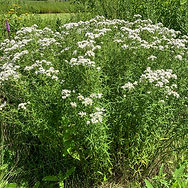
Pycnanthemum virginianum
(Virginia mountainmint)

Verbena
(vervains)

Thalictrum dasycarpum
(tall meadowrue)

Symphyotrichum, Eurybia
(asters)

Diervilla lonicera
(bush honeysuckle)

Liatris aspera
(rough blazing star)

Helenium autumnale
(sneezeweed)

Monarda punctata
(dotted horsemint)
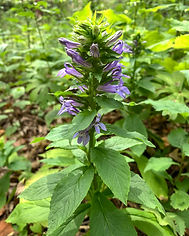
Lobelia siphilitica
(blue lobelia)

Solidago
(goldenrods)

Physostegia virginiana
(obedient plant)

Chamaecrista fasciculata
(partidge pea)

Penstemon gracilis
(slender beardtongue)

Dalea villosa
(silky prairie clover)

Anaphalis maragitacea
(pearly everlasting)

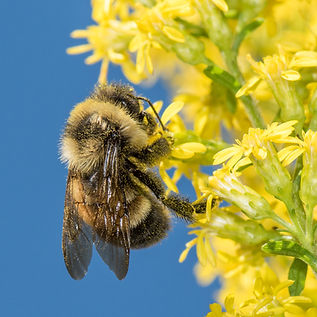
Bombus Species in Minnesota
Scientific Name | Host | Sociality | Nest |
|---|---|---|---|
Bombus affinis | eusocial | below- and on the ground | |
Bombus ashtoni (B. bohemicus) | Bombus affinis and B. terricola. SH rank: possibly extirpated from state | parasitic | |
Bombus auricomus | eusocial | below- and aboveground | |
Bombus bimaculatus | eusocial | below- and on the ground | |
Bombus borealis | eusocial | on the ground | |
Bombus citrinus | Bombus bimaculatus, B. impatiens, B. vagans (Gibbs 2023) | parasitic | |
Bombus fervidus | eusocial | below- and on the ground | |
Bombus flavidus (B. fernalde) | Bombus | parasitic | |
Bombus fraternus | eusocial | belowground | |
Bombus frigidus | eusocial | ||
Bombus griseocollis | eusocial | below- and aboveground | |
Bombus huntii | eusocial | ||
Bombus impatiens | eusocial | belowground | |
Bombus insularis | Bombus ternarius (Williams et al. 2014) B. terricola (Hobbs 1968) | parasitic | |
Bombus melanopygus | eusocial | ||
Bombus nevadensis | eusocial | below- and aboveground | |
Bombus pensylvanicus | eusocial | belowground, on the ground in grasslands, in wood cavities aboveground | |
Bombus perplexus | eusocial | on the ground next to or under objects | |
Bombus rufocinctus | eusocial | on the ground under objects | |
Bombus sandersoni | eusocial | ||
Bombus suckleyi | Bombus - SX rank: presumed extirpated from state | parasitic | |
Bombus ternarius | eusocial | belowground in or next to treed habitat | |
Bombus terricola | eusocial | below- and on the ground | |
Bombus vagans | eusocial | on the ground under debris or object | |
Bombus variabilis | B. pensylvanicus. - SX rank: presumed extirpated from state | parasitic |
Source: Minnesota Department of Natural Resources, Minnesota Bee Species List (August 2023).
https://files.dnr.state.mn.us/eco/mcbs/mn-statewide-bee-list.pdf


_Page_1.jpg)
_Page_2.jpg)
Distribution

Bombus affinis

Bombus ashtoni (bohemicus)

Bombus auricomus


Bombus bimaculatus


Bombus impatiens

Bombus insularis


Bombus melanopygus

Bombus nevadensis


Participatory Science Opportunities



Explore More Apidae Genera

Anthophora

Apis

Bombus

Brachymelecta

Ceratina

Epeolus

Epimelissodes

Eucera

Holcopasites

Melissodes

Neolarra

Nomada

Triepeolus

Xenoglossa

Xylocopa
Explore Bee Families


Apidae
15 genera, 133 species
Bumble bees Bombus
Longhorn bees
Epimelissodes, Eucera, Melissodes
Carpenter bees
Ceratina, Xylocopa
Honey bees Apis
Digger bees Anthophora
Cuckoo bees Brachymelecta, Epeolus, Holcopasites, Nomada, Neolarra, Triepeolus
Squash bees Xenoglossa
2 genera, 39 species

Halictidae
10 genera, 134 species
Metallic green sweat bees
Agapostemon, Augochlora, Augochlorella, Augochloropsis
Large sweat bees
Dieunomia, Nomia
Short-faced bees Dufourea
Sweat bees Halictus
Small sweat bees Lasioglossum
Cuckoo (blood) bees Sphecodes

Megachilidae
14 genera, 86 species
Resin and pebble bees Anthidiellum, Dianthidium, Heriades, Paranthidium
Carder bees Anthidium, Pseudoanthidium
Mock orange bees Chelostoma
Mason bees Osmia, Hoplitis
Leafcutter bees Megachile
Sharp-tailed cuckoo bees Coelioxys
Dark cuckoo bees Stelis

Citations and Further Reading
Droege, S., Shumar, S., & Maffei, C. (2024). The Very Handy Bee Manual (2.0). Zenodo. https://doi.org/10.5281/zenodo.12812755
Gibbs, J., Hanuschuk, E., Miller, R., Dubois, M., Martini, M., Robinson, S., ... & Onuferko, T. M. (2023). A checklist of the bees (Hymenoptera: Apoidea) of Manitoba, Canada. The Canadian Entomologist, 155, e3.
Mitchell, T. B. (1960). Bees of the eastern United States. Technical Bulletin No. 141. North Carolina Agricultural Experiment Station.
Portman, Z. M., Gardner, J., Lane, I. G., Gerjets, N., Petersen, J. D., Ascher, J. S., ... & Cariveau, D. P. (2023). A checklist of the bees (Hymenoptera: Apoidea) of Minnesota. Zootaxa, 5304(1), 1-95.
Williams, P. H., Thorp, R. W., Richardson, L. L., & Colla, S. R. (2014). Bumble bees of North America: an identification guide. Princeton University Press
Wilson, J. S., & Messinger Carril, O. J. (2016). The bees in your backyard: a guide to North America's bees. Princeton University Press.
Page Photography Credits
Heather Holm
Steve Mlodinow CC BY-NC 4.0 (Brachymelecta)
Michelle Orcutt CC-BY-NC 4.0 (Epimelissodes female)
Page Illustration Credits
Elaine Evans, Xerces Society - bumble bee illustrations